
Maryland Unclaimed Money
Maryland's Comptroller holds over $2.76 billion in unclaimed money belonging to residents and former residents of the state. These funds sit in state custody until the rightful owner comes forward to claim them. Searching for unclaimed money in Maryland is free, takes just a few minutes, and can be done online at any time. About 1 in 7 Maryland residents has unclaimed money waiting in the system, and the average claim is worth $2,080. You do not need a lawyer or a paid service to search and file a claim.
Maryland Unclaimed Money at a Glance
How to Search Maryland Unclaimed Money
The official search database is at claimitmd.gov. This is where all Maryland unclaimed money searches begin. Enter a last name, then narrow results by first name, city, or ZIP code. The system checks for name variations and maiden names automatically. Results appear in a table showing the claim number, property type, last known address, the company that reported the funds, and an approximate dollar amount. You can claim more than one property in a single submission.
The main unclaimed property portal at the Maryland Comptroller's website links everything together in one place.
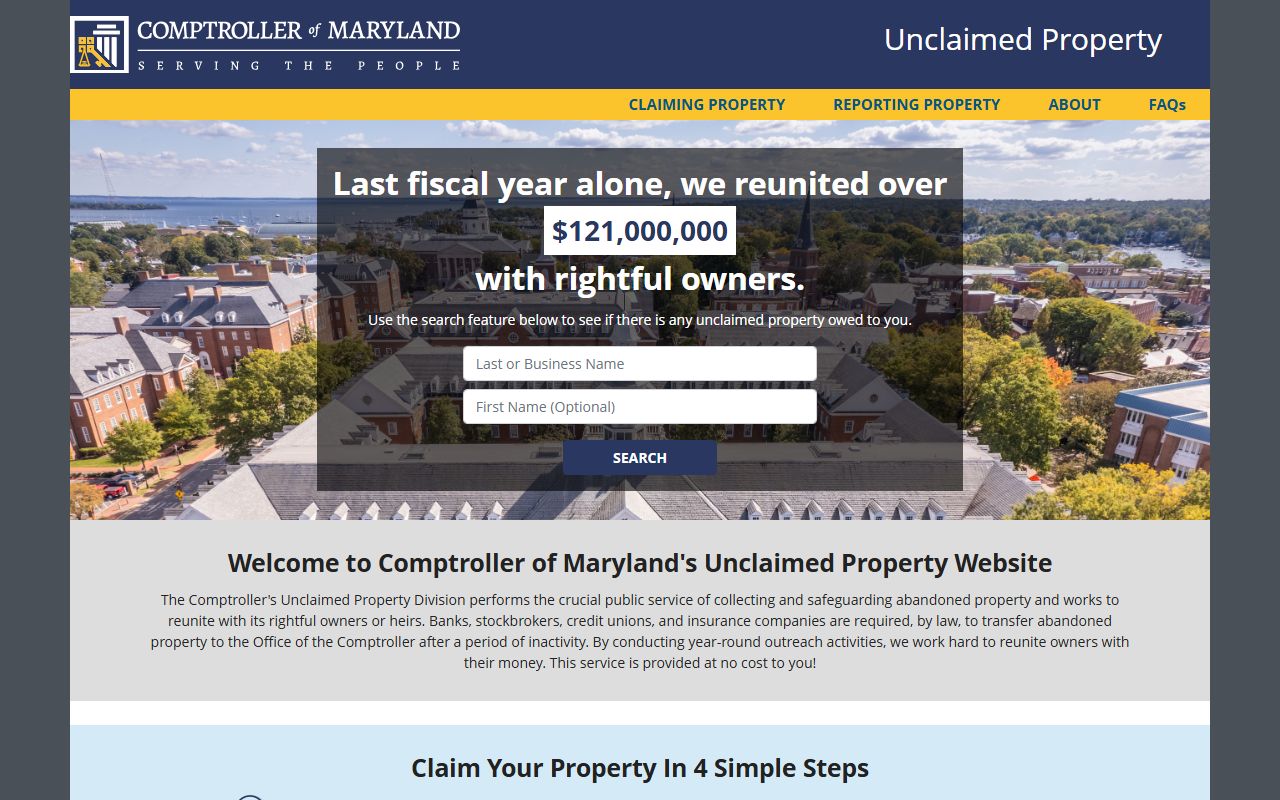
From marylandtaxes.gov/unclaimed-property, you can reach the live search database, the claim submission system, FAQs, and field office locations all from one page.
In October 2025, the state launched a new platform called KAPS (Kelmar Abandoned Property System) to replace the older interface. The legacy search tool still works if you prefer the older layout. Both connect to the same database. If you searched years ago and found nothing, search again. New unclaimed money is added to the system every year as banks, insurers, and other holders file annual reports. Since 2007, Maryland has returned more than $1 billion in unclaimed funds to rightful owners.
The search database at claimitmd.gov is the direct entry point into Maryland's unclaimed property records.

Each result shows a unique claim number in the format MD-XXXXX-XXXXX, which you will need when you file a claim.
What Counts as Unclaimed Money in Maryland
Bank accounts make up the largest share of unclaimed money in Maryland. Checking accounts, savings accounts, certificates of deposit, and money market accounts all go to the state after three years with no owner activity. The same three-year dormancy period applies to most insurance payments, uncashed checks, utility deposits, and security deposits. Stocks, bonds, mutual funds, and dividends also enter the unclaimed property fund when the holder loses contact with the owner. Under Commercial Law §17-102, property is presumed abandoned once the dormancy period passes and the holder cannot reach the owner.
Safe deposit box contents follow a separate process. When a box goes dormant, the bank transfers the physical items to the Comptroller's office. Staff photograph and catalogue every item, then sell them at public auction. The money from those sales goes into an account for the former owner and stays there indefinitely. Even if the original property is gone, the proceeds remain claimable.
Not every property type waits three years. Money orders sit for seven years. Traveler's checks go fifteen years before the state takes custody. Tax refunds, court disbursements, and government benefit payments can also become unclaimed money in Maryland when they go uncashed and the issuing agency cannot locate the recipient.
Note: Maryland is a custodial state under Commercial Law §17-401, meaning there is no time limit to claim property. The state holds funds indefinitely for the rightful owner or their heirs.
How Unclaimed Money Ends Up With Maryland
Banks, insurance companies, brokers, and other businesses are required by law to report unclaimed property to Maryland each year. This process is called holder reporting. Under Commercial Law §17-301, holders must file annual reports and remit funds to the Comptroller by October 31. Once remitted, the state takes legal custody under §17-303 and begins holding the funds for the owner. Holders that fail to report face civil penalties and interest charges.
The reporting requirement applies to any company doing business in Maryland or holding assets belonging to Maryland residents, even if the company is based out of state. In FY2023, $315 million in new unclaimed money was reported to Maryland. That same year, the state returned $81 million to rightful owners. Businesses and financial institutions that need to report can find instructions and filing tools at the Comptroller's holder reporting page.
The holder reporting page at marylandtaxes.gov gives businesses everything they need to file annual unclaimed property reports under Maryland law.
Holders must file by October 31 each year and remit all funds that have passed the applicable dormancy period.
How to Claim Unclaimed Money in Maryland
The fastest method is online through the Maryland OneStop portal. Create a free account, log in, and go to the unclaimed property section. Enter the claim number from your search results, complete all required fields, and upload scanned copies of your documents. Once submitted, you will receive a confirmation email with a tracking number. Online claims typically process in 6 to 12 weeks, depending on complexity and the time of year.
The OneStop portal at onestop.md.gov handles digital claim submissions for Maryland unclaimed money with built-in document upload and claim status tracking.
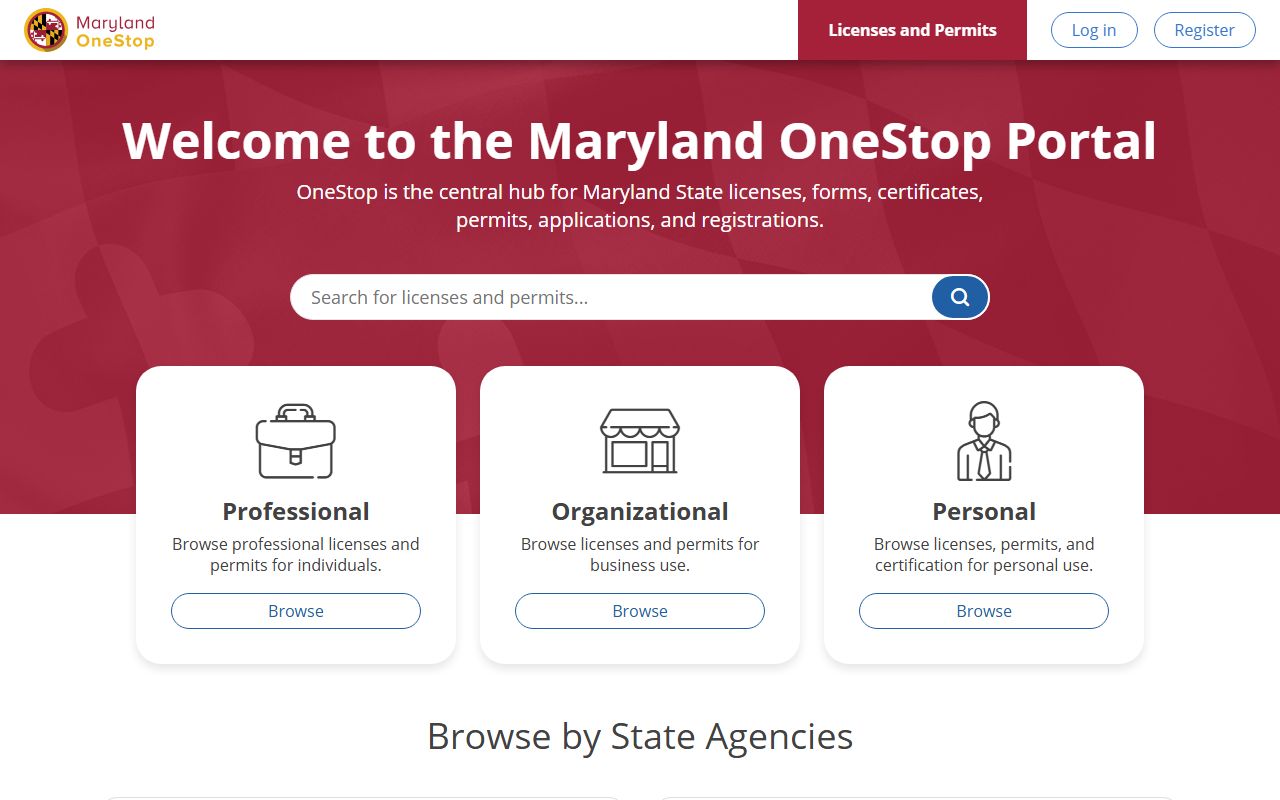
After submitting, log back in and check "My Records" to track your claim status at any point during the review process.
Mail is the other option. Download form COT-ST912 from the Comptroller's website, print it, fill out every section, attach copies of required documents, and send to: Comptroller of Maryland, Unclaimed Property Division, 7 St. Paul Street, Suite 320, Baltimore, MD 21202. Paper claims take 12 to 24 weeks. For questions about which method to use for a large or complex claim, call 410-767-1700.
The COT-ST912 claim form covers all claim types in one document: individual, joint, estate, and business.
Print two copies before mailing: one to submit and one to keep until the claim is fully resolved.
Status categories in the OneStop system are: Submitted, In Review, Pending Info, Approved, Paid, Denied, and On Hold. If your claim moves to Pending Info, check your email and the portal message center for a document request. Reach the division at unclaim@marylandtaxes.gov or toll-free at 1-800-782-7383. Hours are Monday through Friday, 8:30 AM to 4:30 PM ET. TTY callers can reach the office at 410-767-1967.
What You Need to File a Claim
Two documents are required for every Maryland unclaimed money claim. First, a government-issued photo ID. A driver's license, state ID card, passport, or military ID all qualify. Second, proof of your Social Security number. A Social Security card works, but so does a W-2, a 1099, or a copy of a tax return. These two items are the baseline regardless of claim type.
Additional documents depend on what you are claiming. For bank or investment accounts, a statement showing your account number helps connect you to the record in the database. Insurance claims may require a policy number or original policy document. If your name changed due to marriage or divorce, include a marriage certificate or divorce decree to explain the discrepancy between your current name and the name on the account. The Comptroller may request further verification at any point, so keep all original documents until the claim is fully paid.
Estate and heir claims require a death certificate for the original owner plus Letters Testamentary or Letters of Administration from probate court. In some small estate situations, an affidavit may be accepted instead. Business claims need a completed W-9, corporate formation documents, and an authorized representative's photo ID. The Comptroller's FAQ page covers documentation requirements for every claim type in detail.
- Government-issued photo ID (license, passport, state ID, military ID)
- Social Security proof (SS card, W-2, 1099, or tax return copy)
- Completed COT-ST912 form with your claim number
- Account statements or policy documents as applicable
- Death certificate and estate documents for deceased owner claims
- Marriage or divorce certificate for name changes
- W-9 and corporate authorization for business claims
Maryland Unclaimed Money Laws and Rules
Maryland's unclaimed property program is governed by the Commercial Law Article, Title 17. Section 17-101 defines the key terms used throughout the statute, including what counts as a holder and what types of assets fall under the law. These definitions matter when a claim gets disputed or when you are trying to recover property on behalf of an estate.
One protection that every claimant should know about is in §17-404, which governs finder agreements. Some companies offer to find unclaimed money on your behalf and charge a percentage fee. Under Maryland law, such agreements are not enforceable if the property has been in state custody for less than two years. Always search at claimitmd.gov first. It is free, and it takes just a few minutes.
Maryland updated its unclaimed property law significantly in 2023. House Bill 1031 and Senate Bill 858 added provisions for virtual currency, adjusted dormancy timelines, and gave the Comptroller stronger enforcement tools. In 2025, the state also began automatic delivery of small claims under $5,000 directly to owners without requiring a formal claim submission. Property sold by the state, including safe deposit box auction proceeds, remains claimable indefinitely under §17-501.
The legacy search tool at marylandtaxes.gov remains available for older database records and cross-reference searches.
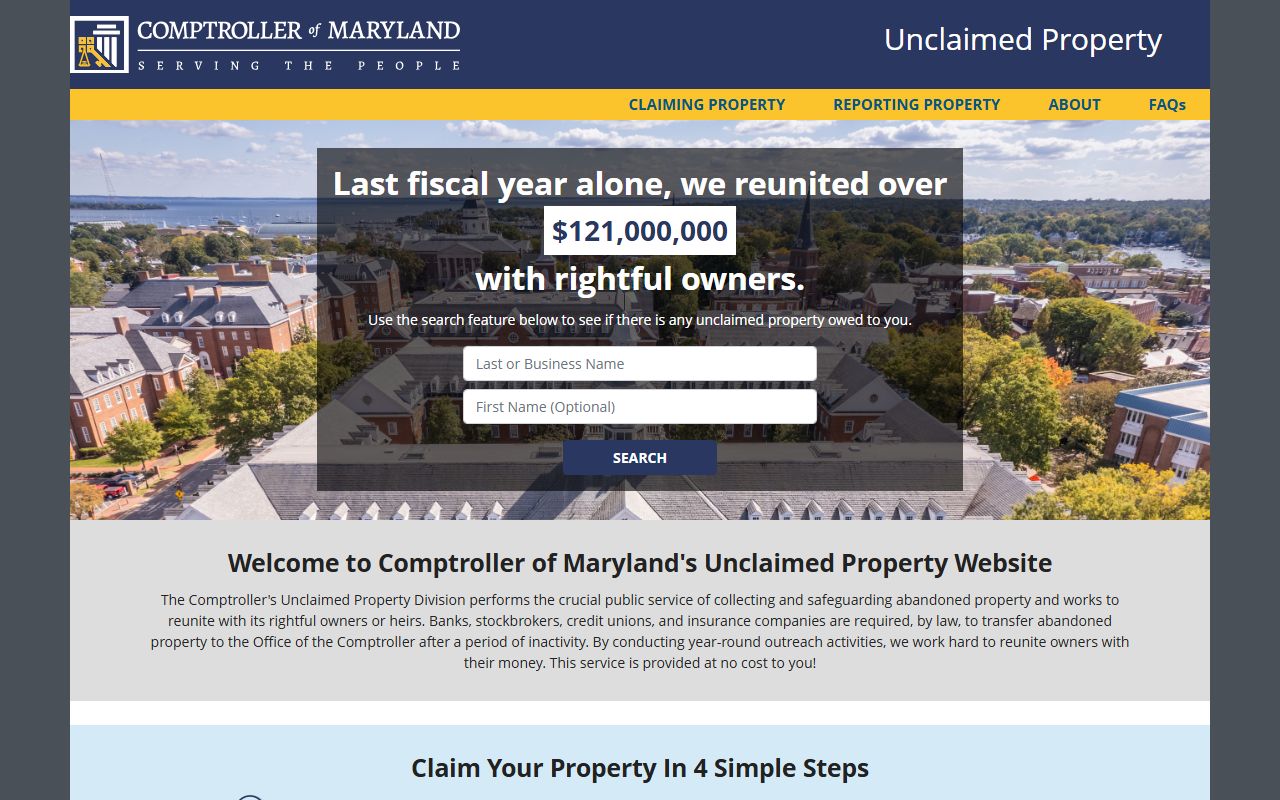
The older interface is useful for verifying records that predate the KAPS system launched in October 2025.
Comptroller Field Offices Across Maryland
The Comptroller's main unclaimed property office is at 7 St. Paul Street, Suite 320, Baltimore, MD 21202. You can visit in person, call 410-767-1700, or email unclaim@marylandtaxes.gov. All offices are open Monday through Friday. Hours vary by location, so call ahead before visiting.
Eight field offices serve communities across the state. For Western Maryland, there are offices in Hagerstown at 5 Public Square and Cumberland. The Frederick office at 5310 Spectrum Drive covers the I-270 corridor and surrounding Frederick County communities. The Bel Air office at 2 South Bond Street serves Harford County. Elkton at 170 East Main Street is the closest option for Cecil County residents. For the Eastern Shore, the Salisbury office at 1306 South Salisbury Boulevard handles Wicomico and nearby counties. In the DC suburbs, the Wheaton office at 11002 Veirs Mill Road and the Waldorf office at 1036 St. Nicholas Drive serve the area.
The Comptroller's field office locations page lists hours, phone numbers, and driving directions for every branch.
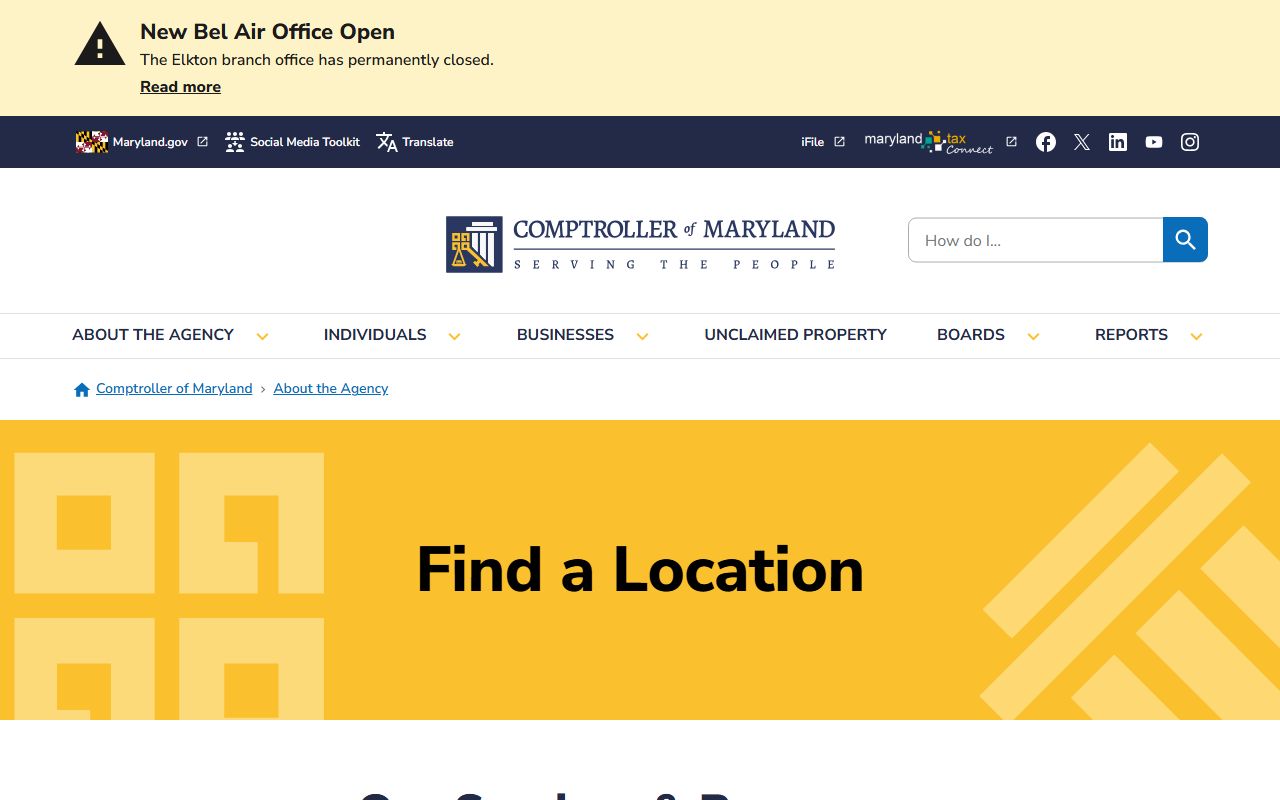
Field office staff can answer questions about unclaimed money claims, help with documentation, and direct you to the right resources.
Maryland Unclaimed Money FAQ
There is no deadline to claim. Maryland law is custodial, which means unclaimed money stays in state accounts until the rightful owner or their heirs come forward. It does not matter if the property went dormant five years ago or thirty years ago. The right to claim does not expire.
Searching and filing a claim is always free through the official system. The Comptroller does not charge fees for any step of the process. If someone contacts you offering to find your unclaimed money for a fee, check the state database yourself first at claimitmd.gov before agreeing to anything. Most searches take under five minutes.
Search your name in every variation you have used. Try your full first name and your initials separately. Search maiden names and any previous married names. Run searches under any business names you have registered in Maryland. Also consider searching for deceased relatives whose estate you may have a right to claim. The system checks for common name variations automatically, but running multiple searches is still a good practice. Detailed answers to dozens of common questions are at the Comptroller's FAQ page.
The Comptroller FAQ page covers questions about searching, claim documentation, estate claims, processing times, and finder agreements.
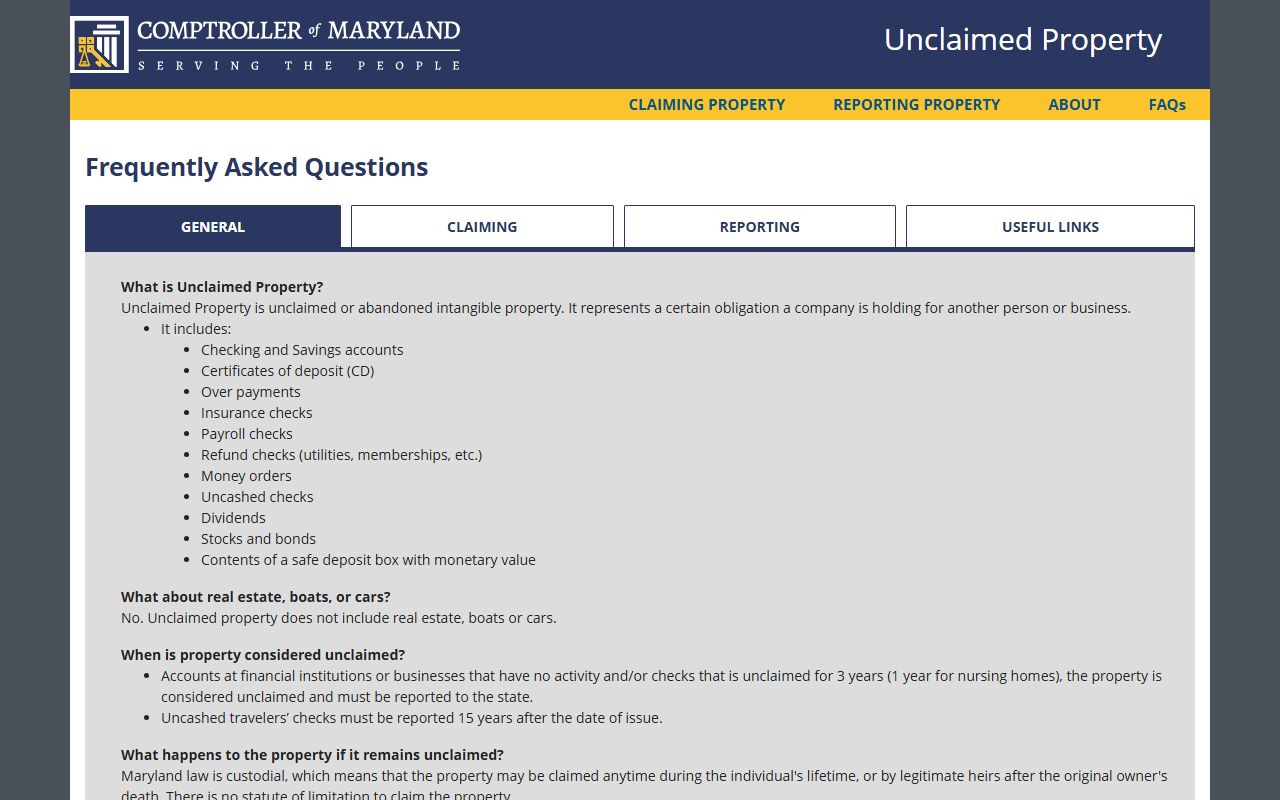
If your question is not listed there, call 410-767-1700 or email unclaim@marylandtaxes.gov for a direct answer.
You can also search across multiple states at once using MissingMoney.com, a free national database maintained by the National Association of Unclaimed Property Administrators (NAUPA). Maryland also participates in multi-state data-sharing agreements covering 43 states and DC. If you have lived in other states, both searches are worth running.
About the Maryland Comptroller Unclaimed Property Program
The Maryland Comptroller's unclaimed property program has returned more than $1 billion to owners since 2007. In FY2023, the program distributed $81 million. The total balance held currently exceeds $2.76 billion across more than 1.3 million accounts. The program is fully funded by holding dormant assets until owners claim them and does not rely on tax revenue.

The Comptroller's unclaimed property page links to all program resources including news releases, legislative updates, and annual reports.
For direct questions, the contact page has a secure message form plus phone and email details. Reach the division at 410-767-1700, toll-free 1-800-782-7383, or unclaim@marylandtaxes.gov.
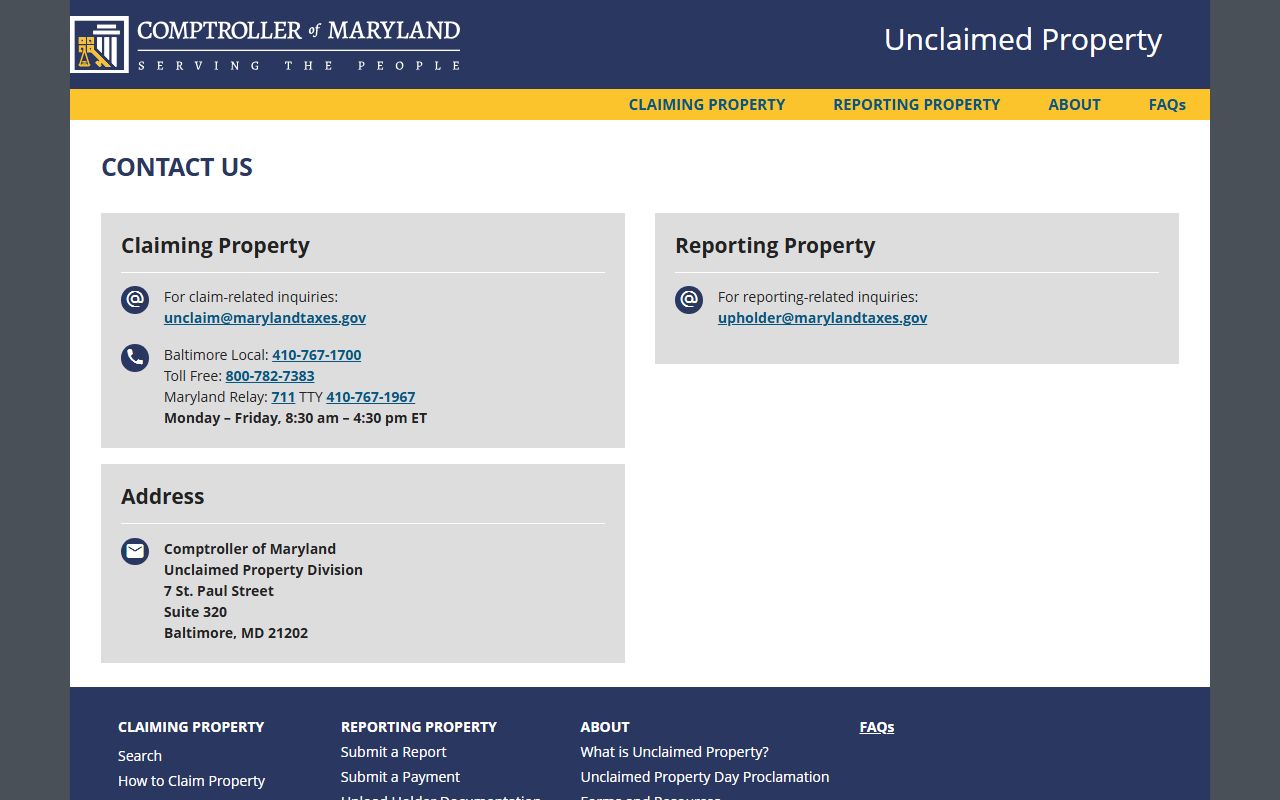
All contact methods go directly to the Unclaimed Property Division, not to a general call center.
Search Maryland Unclaimed Money by Location
Unclaimed money in Maryland is managed at the state level by the Comptroller, but local county offices handle tax sale surplus funds and other location-specific programs. Select a county below to find offices, contact details, and local resources in your area.
Maryland Unclaimed Money by City
Some Maryland cities have their own local tax sale programs and Comptroller field offices. Select a city below to find local resources and information specific to your community.