
Queen Anne's County Unclaimed Money Search
Queen Anne's County residents can search for unclaimed money held by the Maryland Comptroller's office, which manages all unclaimed property in the state. Dormant bank accounts, forgotten refunds, uncashed checks, and utility deposits from across the Eastern Shore and Western Shore are all searchable through Maryland's free online database. If you live in Centreville, work near the Bay Bridge corridor, or own land in Queen Anne's County, there is a real chance money is sitting under your name right now.
Queen Anne's County Unclaimed Money Overview
How Queen Anne's County Unclaimed Money Works
Maryland does not run county-level unclaimed property programs. The state Comptroller's office handles all unclaimed funds from every county, including Queen Anne's. When a bank, insurance company, utility provider, or other business loses contact with a customer, they must turn over that money to the state after a dormancy period. For most account types, that period is three years. Money orders go dormant after seven years. Traveler's checks reach the state after fifteen years.
Once the Comptroller holds your money, there is no deadline to claim it. Maryland law is custodial, meaning the state keeps the funds safe until the rightful owner comes forward. Under Maryland Code General and Commercial Law §17-101, the state defines what counts as abandoned property. The system is built to protect owners, not take their funds permanently.
Queen Anne's County sits at a unique crossroads. Residents here often have accounts and business ties on both the Eastern Shore and in the Baltimore-Washington metro area. The Bay Bridge corridor means many people commute west for work while banking locally, or vice versa. That dual-region financial life can lead to dormant accounts in places you may have forgotten about.
Note: The Maryland Comptroller reports that roughly 1 in 7 Maryland residents has unclaimed money waiting. Queen Anne's County residents are encouraged to search even if they do not expect to find anything.
Searching for Queen Anne's County Unclaimed Funds
The primary search tool is the ClaimItMD portal at claimitmd.gov. You do not need to pay anything to search. Enter your name as it appeared on old accounts, your current or past addresses, and your Social Security number when prompted. The search covers all 24 Maryland jurisdictions, so any money tied to your name statewide will show up in one place.
The Maryland Comptroller's main unclaimed property portal provides access to the search database, claim filing tools, and documentation guides. The screenshot below shows the portal homepage where residents start their search.
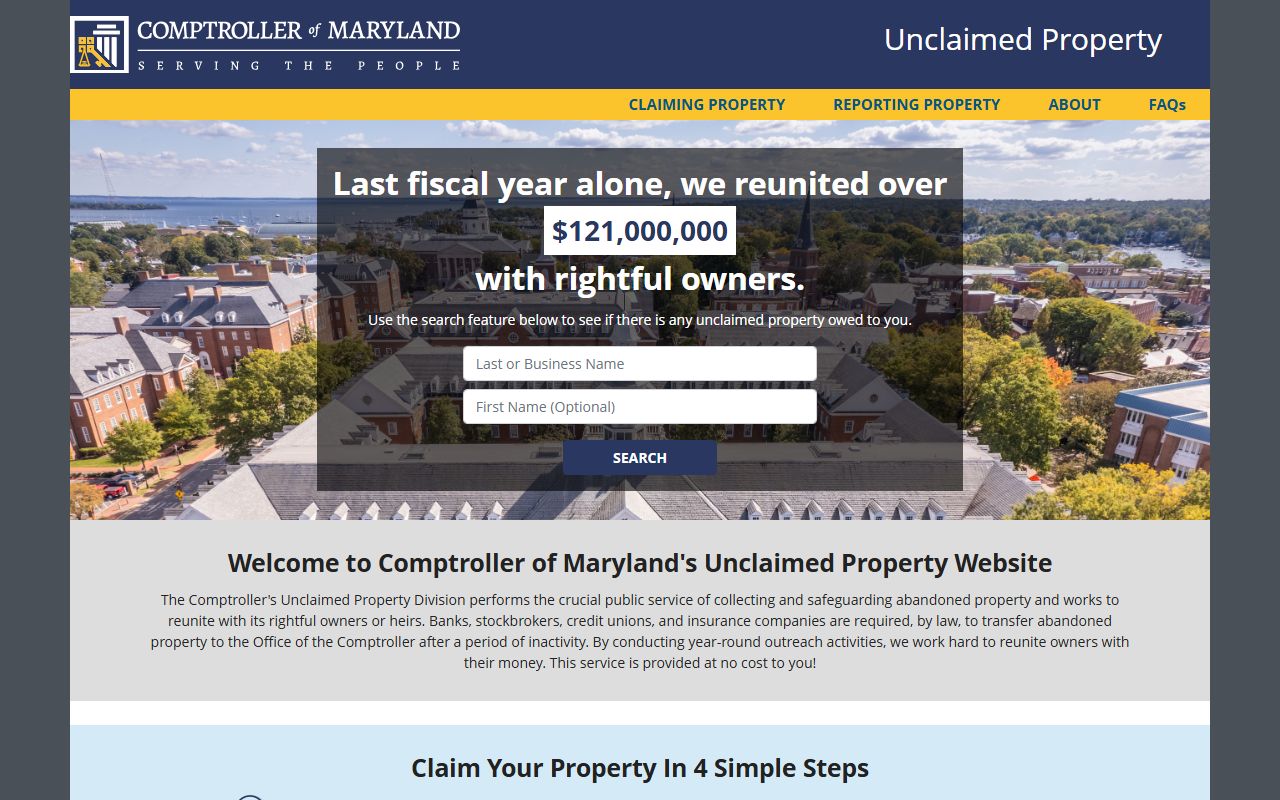
From this portal you can move directly into the search tool, review what documents you will need, and get help if your name appears in multiple records.
You can also search MissingMoney.com, a multi-state database that includes Maryland records. This is useful if you have lived in other states and want to run one broad search. The results will point you back to each state's official claim process.
Note: Always search using maiden names, previous names, and business names if you have operated a business in Queen Anne's County.
Common Sources of Unclaimed Money for Queen Anne's Residents
Queen Anne's County has a mix of agricultural land, watermen communities, and suburban households that commute to Baltimore or Annapolis. Each group tends to have different sources of unclaimed funds. Watermen and seasonal workers in the Bay's fishing and crabbing industries sometimes have unclaimed wages or co-op payments from processors. Agricultural landowners may have dormant refunds from equipment co-ops, crop insurance overpayments, or government agricultural programs.
Commuters who bank in Baltimore or the metro area and later move or change jobs can leave behind small savings accounts, payroll refund checks, or security deposits. Utility providers in both the Eastern Shore and Western Shore regions report unclaimed deposits each year. When you move and close an account, a final refund check sometimes gets lost in the mail or sent to a wrong address. Those checks eventually make their way to the state.
Businesses registered in Queen Anne's County should also check. Dormant business accounts, unprocessed vendor refunds, and closed commercial accounts all get turned over to the Comptroller. The Queen Anne's County Finance Department can answer questions about local tax overpayments, but statewide unclaimed property goes through the Comptroller's office directly.
How to File a Queen Anne's County Unclaimed Property Claim
Once you find a match in the database, the claim process has a few clear steps. You will need to prove your identity and your connection to the funds. Most claims require a government-issued photo ID, proof of your Social Security number, and the completed claim form COT-ST912.
The COT-ST912 form is available from the Maryland Comptroller's office. The screenshot below shows the claim form PDF, which you can download and complete before submitting your claim.
Submit the form and supporting documents online through the ClaimItMD portal for the fastest processing. Online claims typically take 6 to 12 weeks. Mailed claims to 7 St. Paul St., Suite 320, Baltimore, MD 21202 can take 12 to 24 weeks.
For larger claims or complex situations, you can contact the Comptroller's unclaimed property division directly. The phone number is 410-767-1700 or toll-free at 1-800-782-7383. Email support goes to unclaim@marylandtaxes.gov. Staff are available Monday through Friday, 8:30 AM to 4:30 PM. Queen Anne's County residents who prefer an in-person visit can go to the Baltimore main office or the Elkton field office, which is the closest Comptroller location for Eastern Shore residents.
Under Maryland Code §17-301, the state holds these funds in trust. You are the rightful owner regardless of how long the money has been sitting with the state.
Queen Anne's County Property Tax Sales and Excess Funds
When property in Queen Anne's County goes to tax sale for delinquent taxes, the sale proceeds sometimes exceed the amount owed. That surplus belongs to the former property owner or other lien holders. This is a separate process from the state unclaimed property program, but it is worth checking if you or a family member has ever lost property to a tax sale in the county.
The Queen Anne's County Finance Department tax sale page has information about how the tax sale process works locally. If you believe excess funds exist from a prior sale, contact the Finance Department at the county government offices in Centreville. The county government main site at qac.org can point you to the right department.
Note: Tax sale excess funds and state unclaimed property are separate systems. You may need to check both if you are researching older accounts or properties.
Maryland Unclaimed Property Law and Your Rights
Maryland's unclaimed property statutes protect your right to claim funds at any time. Section 17-102 outlines which types of property are subject to the law. Section 17-401 describes the claims process and what the Comptroller must do when someone files. Section 17-404 covers the rights of claimants, including situations where multiple people claim the same funds.
There is no charge to search or file a claim. Be cautious of third-party finders who offer to recover your funds for a fee. Maryland law limits the fees these companies can charge, and you can always file directly for free. If someone contacts you claiming they found money under your name and wants a percentage to get it, check the state database yourself first before agreeing to anything.
Nearby Counties
Unclaimed money can come from activity in neighboring counties. If you have lived or worked in any of these areas, search under your name there as well.
Qualifying Cities Near Queen Anne's County
No cities within Queen Anne's County meet the population threshold for a dedicated page. The nearest qualifying cities are in the Baltimore metro area and the broader Central Maryland region. Residents with ties to those areas may want to check those pages for additional guidance.